A Practical Guide to Russian River Cabin Ownership
May 7, 2026
May 7, 2026
Dreaming about a cabin under the redwoods with river days in the summer and cozy weekends all year? Owning a cabin in Rio Nido can absolutely deliver that kind of lifestyle, but it also comes with practical questions about access, maintenance, utilities, insurance, and seasonal risk. If you are thinking about buying in this part of the Russian River area, it helps to know what ownership really looks like before you fall in love with the setting. Let’s dive in.
Rio Nido is a small unincorporated hamlet along the Russian River where Rio Nido Creek meets the river. Sonoma County Tourism describes it as a place of summer homes and cabins on the hillsides, anchored by a historic lodge, roadhouse, post office, fire station, and community pool.
That gives Rio Nido a different feel from a typical subdivision. When you buy here, you are often buying into a classic getaway setting shaped by redwoods, canyon roads, and a slower seasonal rhythm.
For many buyers, the appeal is simple. You get river access, wooded scenery, and easy proximity to Guerneville’s outdoor recreation and wine country amenities. If you want a place that feels tied to nature rather than a standard neighborhood pattern, Rio Nido stands out.
Summer is when the Russian River area is at its most active. Sonoma County Regional Parks says paddling on the Russian River is typically best from May through September, and that seasonal pattern shapes how many owners use their cabins.
In Rio Nido itself, the Roadhouse pool is open from Memorial Day Weekend through Labor Day Weekend with a lifeguard on duty. That adds to the area’s classic summer-community feel, especially for owners who want a low-key place to gather and cool off.
River safety matters too. Sonoma County Regional Parks notes that most river beaches are not lifeguarded, cell reception can be limited or absent, and seasonal loaner life jackets are available at the busiest beaches.
The river area does not shut down after summer, but the mood changes. Sonoma County Regional Parks describes the Russian River as a year-round fishing destination, and local access points also support birding and wildlife viewing.
Nearby redwood destinations, including Armstrong Redwoods and the broader redwood corridor around Guerneville and Monte Rio, help make the area appealing beyond hot-weather weekends. If you want both water and woods in one ownership experience, this pocket of Sonoma County offers that mix.
Winter, however, is when ownership becomes more hands-on. Sonoma Water says atmospheric rivers account for about half of the major rainfall in the Russian River watershed, and Sonoma County emergency materials note that lower Russian River communities, including Rio Nido, have been affected by flood and debris-flow events.
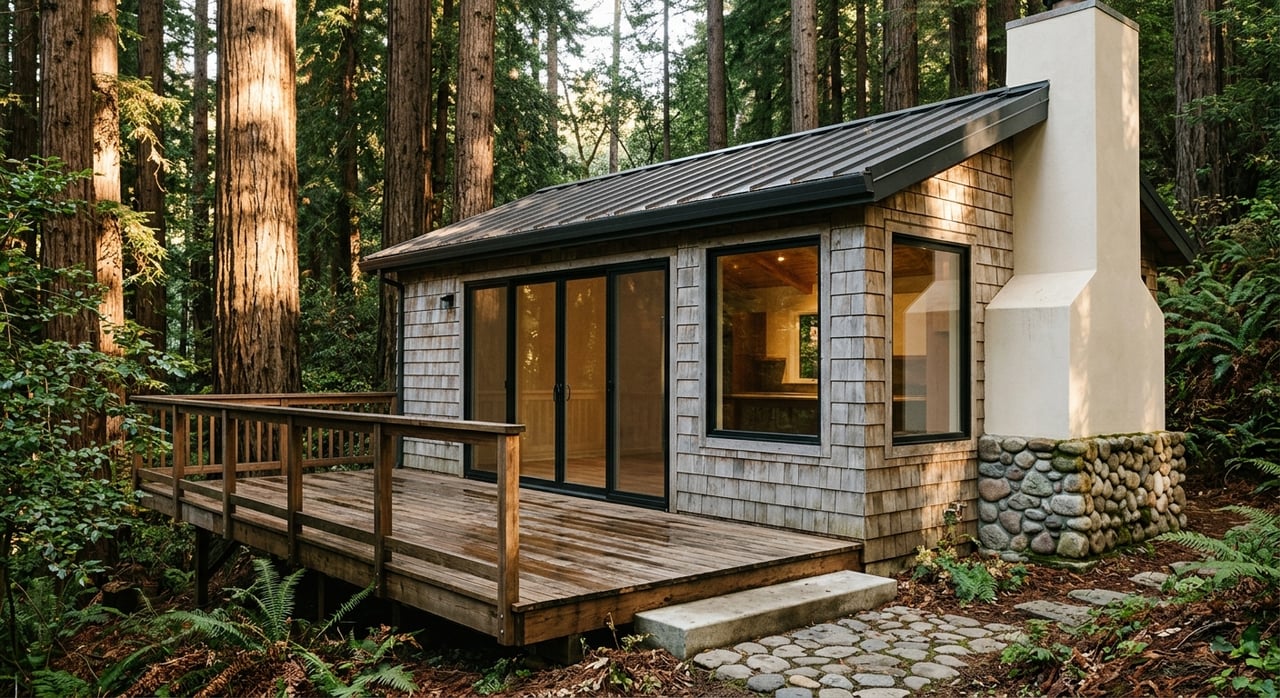
Many cabins in Rio Nido are older, compact homes set into wooded slopes or canyon terrain. Sonoma County Tourism’s description of cabins on the hillsides is a good way to picture what many buyers encounter in this area.
That often means the layout and lot are part of the story. You may see smaller footprints, decks, stairs, outdoor living areas, and properties where parking, access, drainage, and slope stability matter just as much as square footage.
In a redwood canyon setting, upkeep is not just cosmetic. Leaves, needles, moisture, shade, and slope runoff can all affect how a property performs over time.
CAL FIRE recommends pairing defensible space with home hardening measures such as a Class A roof, ember-resistant vents, debris-free decks, and a 100-foot defensible-space buffer where required. For cabin owners, that means regular maintenance is part of protecting both the home and your insurability.
One of the smartest steps a cabin buyer can take is verifying utility service at the start. Sweetwater Springs Water District says it serves Guerneville, Rio Nido, Monte Rio, and Villa Grande, while Sonoma Water says the Russian River County Sanitation District serves Rio Nido and nearby lower-river communities.
That does not mean every property works the same way. It is important to confirm whether a specific home is connected to district water and sewer or instead relies on a private well, septic system, or some combination.
This matters even more in an older cabin market. Sonoma Water’s CEQA materials note that parts of the local sanitation system were built in the 1970s and 1980s and have historically been inundated during high-water events, which is why infrastructure history should be part of your due diligence.
If a home has a private well, Sonoma County Environmental Health says the only way to know whether well water is safe is to test it. That is especially important in a market where you may be looking at older homes, seasonal occupancy, and systems that are not obvious from a showing.
If a property is on septic, future plans matter. The State Water Board’s onsite wastewater policy and Permit Sonoma’s septic guidance both note that local approval is required for septic-served accessory dwelling units, and added development can trigger system review.
In plain terms, if you hope to expand the home, add an ADU, or change how the property is used, septic capacity becomes part of the conversation early.
Many Rio Nido lots sit on hillsides or in erosion-prone conditions. Permit Sonoma makes clear that grading and drainage work can require permits and reports, so buyers should not assume every retaining wall, drainage fix, stairway, or lot improvement was informal and harmless.
For older cabins, permit history is worth reviewing closely. Permit Sonoma maintains public property permit records, which can help you evaluate past additions, decks, drainage work, septic issues, or other improvements that may affect value and future plans.
Some buyers consider a cabin partly for personal use and partly for future rental potential. In unincorporated Sonoma County, Permit Sonoma says a Vacation Rental License is required to operate a vacation rental, and other local permits and tax registrations may apply.
It is also important to know that the license expires when the property is sold or transferred. If vacation-rental potential is part of your purchase decision, you will want to verify the current rules and the property’s status rather than assuming a past setup transfers automatically.
Cabin ownership in the Russian River area should include an emergency plan from day one. Sonoma County’s SoCoAlert system is the county’s official emergency notification tool for evacuation warnings, flood warnings, and similar alerts.
CAL FIRE’s Fire Hazard Severity Zone mapping is also an important reference point for wildfire risk. Sonoma County has funded the Rio Nido Shaded Fuel Break Project as part of vegetation-management work in the lower river area, which shows how seriously this issue is treated locally.
Insurance deserves early attention too. The California Department of Insurance says the FAIR Plan is the insurer-of-last-resort option and should be considered only after a diligent search for traditional coverage, while also pointing to wildfire-mitigation discounts for homes with qualifying hardening features.
Flood risk is just as important as fire risk in this area. FEMA says flood maps are the official way to identify whether a property is in a high-risk flood area, including areas with a 1% annual chance of flooding.
County storm response notices have specifically included Rio Nido in flood-related emergency actions. Because of that, buyers should confirm the parcel’s flood zone, ask whether flood insurance may be required by a lender, and understand how the property handles major winter storms.
If you are seriously considering a Rio Nido cabin, here are a few smart questions to ask before you write an offer:
A cabin purchase here is rarely just about the house itself. You are also evaluating the lot, utility setup, seasonal access, emergency planning, and the practical realities of owning in a wooded river environment.
That is where local, detail-oriented guidance makes a real difference. When you understand how a property functions in both July and January, you can buy with a lot more confidence.
If you are exploring cabins in Rio Nido or anywhere in the Russian River area, Brianna Benz can help you evaluate the details that matter and guide you through the process with clear, responsive support.

Get assistance in determining current property value, crafting a competitive offer, writing and negotiating a contract, and much more. Contact Brianna today to discuss all your real estate needs!